Secrets of Cracking PM Interviews - From Someone Who Has Taken More Than 100+ PM Interviews
Inside a Live AI PM Interview: The 3 Signals Hiring Managers Look For and Why Most Candidates End Up as "Wait and See"

There’s a pattern I’ve noticed across hundreds of PM interviews I’ve conducted and observed: most candidates prepare to answer questions. The best candidates prepare to control the conversation.
In a recent live mock session, I interviewed Anjaneya - a technically sharp candidate from our PM community - on a real-world technical question: “What are the failure points in agentic AI systems?” What unfolded in those 30 minutes taught our entire cohort more about PM interviews than months of solo prep ever could. Here’s what I want you to take away.
The Three Signals Every Technical Interviewer Is Hunting
When I sit across from a candidate in a technical round, I'm not running through a checklist in sequence. I'm hunting for three distinct signals, and I'll steer the entire conversation to find them or confirm their absence.
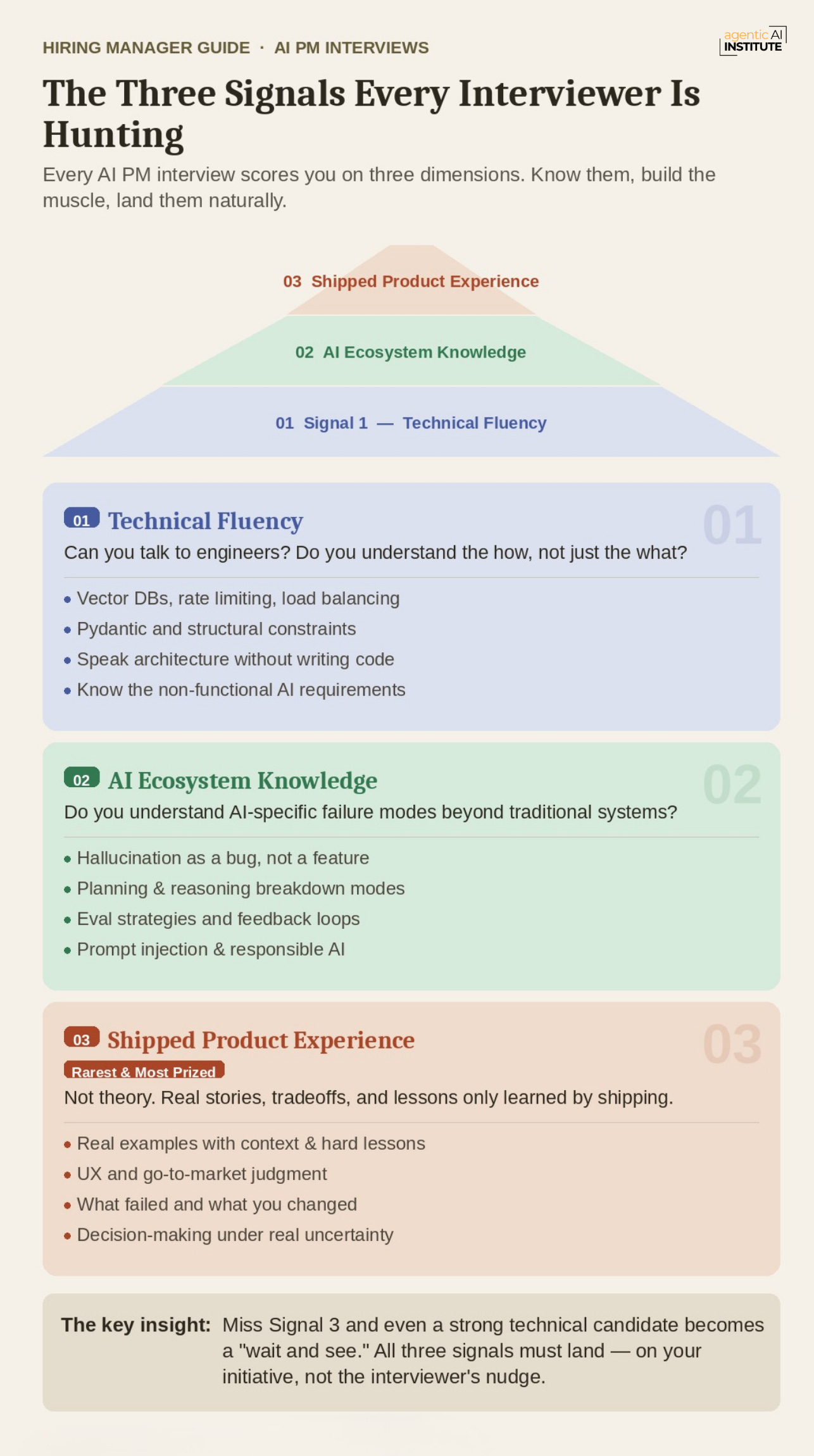
Signal 1: Can you talk to engineers?
This is table stakes. I need to know you won’t freeze when an engineer drops terms like “vector store,” “rate limiting,” “Pydantic,” or “load balancer” in a meeting. You don’t need to implement these things. You need to know when they matter and why - well enough to write the requirement.
Anjaneya cleared this immediately. In his first few minutes, he moved through vector databases, identity management, job queues, and rate-limiting in LLMs with confidence. I noted it and moved on. Signal acquired.
Signal 2: Do you understand the AI-specific terrain?
Once I know you can speak engineering, I want to know if you’ve thought deeply about the new failure modes that AI introduces - the ones that don’t exist in a traditional CRUD system.
Anjaneya covered ground here too: goal misinterpretation in planning and reasoning, hallucinations that are “a feature for LLMs but a bug for agents,” rigid linear pipelines that fail when reality deviates. He even brought in structural constraints like Pydantic to tame non-determinism without over-engineering.
I was getting what I needed. But I had one more signal to find.
Signal 3: Have you actually shipped something?
This is the hardest signal to fake and the most important one to land. Concepts are cheap. Influencer blogs and LinkedIn posts have made everyone fluent in AI terminology. What I need to know is: have you applied these lessons in the real world, made mistakes, and learned from them?
This is where I started nudging Anjaneya.
The Nudge System: How Interviewers Push You Toward Real Signals
Here’s something most candidates don’t know: when an interviewer interrupts you or changes the direction of a question, it’s almost never random. It’s a deliberate signal that you’re not giving them what they need.
I use a three-tier nudge system:
Nudge 1 (–1 point): A soft redirect. I ask for a specific example. “Can you walk me through a real case where planning and reasoning failed?” If you respond with a real story, great. If you stay abstract, I note it.
Nudge 2 (–2 points): A harder redirect. I narrow the scope. I stop letting you roam. I asked Anjaneya about what happens when you put too many guardrails on an agent - I was pushing him to land on user experience and go-to-market consequences, not just technical tradeoffs. He went technical again.
Nudge 3 (Scenario): I create a product situation from scratch, on the spot - designed to force you off the technical path and onto the product one. For Anjaneya, I invented a property management AI application where 36% of queries were about electrical issues, but the agent was giving questionable recommendations, and customers were pushing back. Should you shut it down? Why? What do you do?
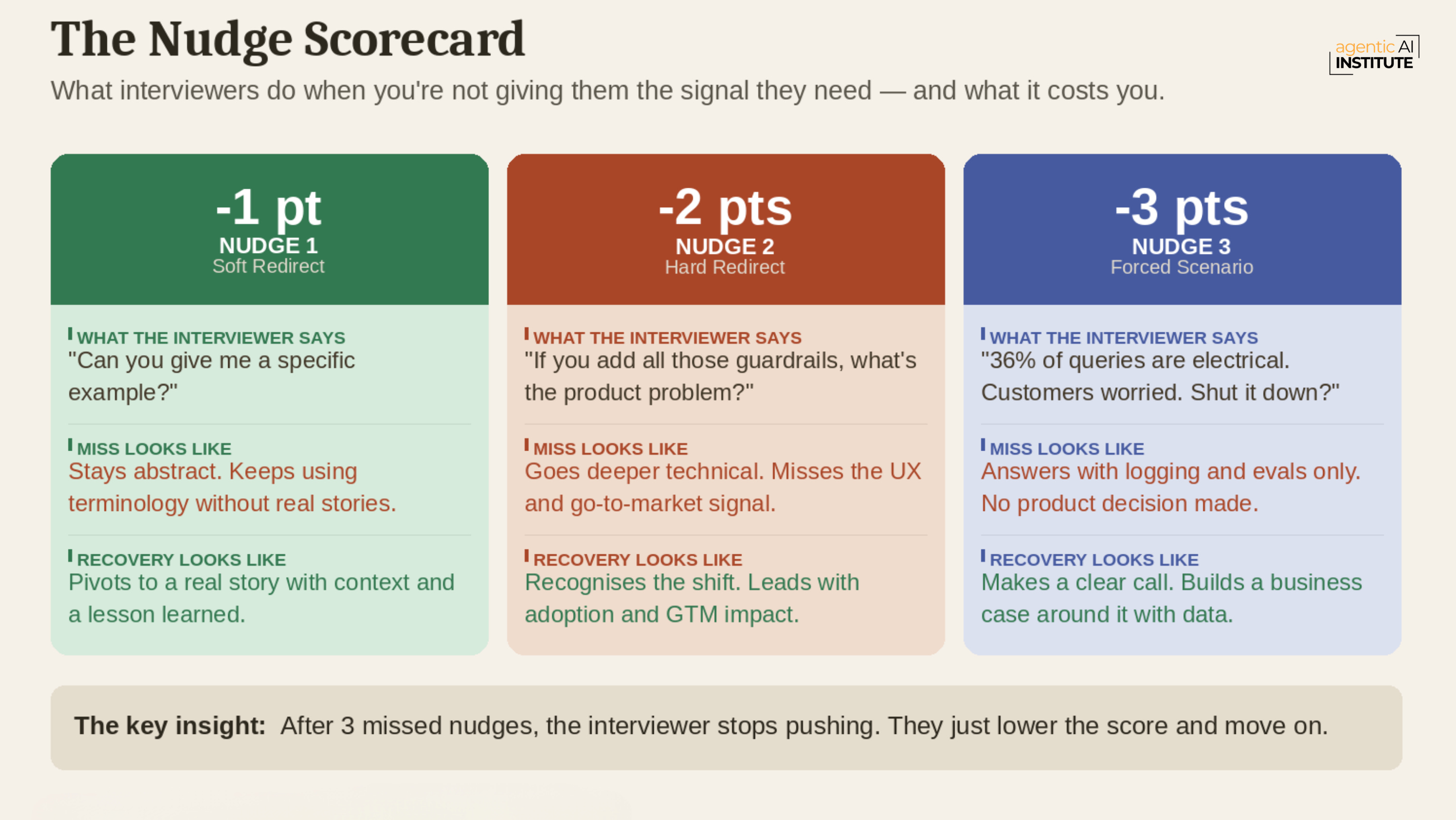
This wasn’t a trivia question. It was a window into how you think under pressure, how you balance risk and revenue, and whether you can hold a PM’s perspective when things get hard.
The Property Manager Problem: What the Right Answer Looks Like
The scenario I gave Anjaneya was deliberately ambiguous. There’s no clean right answer, but there are answers that reveal whether you think like a PM.
The wrong instinct: Jump to technical solutions - better logging, better evals, replay the transaction tree. These aren’t wrong, but they answer an engineering question when I asked a product one.
The PM instinct: Start with a decision. Pick a side. Then defend it with business logic.
Here’s how I would have answered it myself:
“I wouldn’t shut it down. If you shut off 36% of your use case every time someone pushes back, you’ll never ship AI to production. But I also wouldn’t ignore the concern. My move: run a rigorous evaluation on every electrical question we’ve ever received, show the results to those customers, build their confidence in the data. In parallel, create a confidence-threshold filter - low-confidence responses get flagged or escalated instead of answered directly. That way, I’m protecting 20% of the queries I’m most confident about, building trust with customers in their language, and still giving engineering a clear path to close the remaining gap. You ship, but responsibly.”
That answer shows decision-making, risk awareness, customer empathy, and go-to-market thinking - all in one.
Note: We break down live architecture and product scenarios exactly like this every single week inside our AI PM Interview Prep Bootcamp
What Happens After You Leave the Room
Something almost no candidate thinks about: the debrief meeting.
After your interview ends, five to seven people - all who interviewed you across different rounds - sit in a room with the hiring manager and their notes. You’re not there. Your ability to speak for yourself is over.
What lives on is what each interviewer wrote down.
In Anjaneya’s case, my notes read something like this:
✅ Strong AI ecosystem knowledge. Can tell us what’s happening in the field and what to trust.
✅ Core architecture design principles. Solid. Would score 9/10.
⚠️ AI product building and UX evaluation strategy. Missed the product signals in the property manager scenario. Scored 5/10.
🔄 Recommendation: Wait and see. Strong on technical dimensions. Let’s interview 5-8 more candidates before deciding.
“Wait and see” is the polite version of a soft no. It means you were good enough not to be eliminated, but not strong enough to generate a “yes, hire them” in that room.
The gap was one signal - product judgment - that I tried three times to pull out. That’s what the difference between an offer and a callback looks like in real life.
The First Call Is Not Small Talk
One question that came up in our session: what about those early recruiter calls? The ones companies describe as “just a casual chat to get to know you”?
Don’t believe it.
At companies like Anthropic, OpenAI, and any Big Tech hiring for AI roles right now, that first 30-minute call has hundreds of qualified applicants behind you. The recruiter or, increasingly, an AI screening agent, has been given a specific list of 7 or 8 signals to check. They are not curious about your career story. They are running a pass/fail filter.
My advice for the first call:
Be bite-sized. Land many things quickly. Don’t tell stories; deliver signals.
Show up fully prepared - not in “relaxed mode.”
Drop the right terms naturally: not in a list, but in sentences that show you understand the context.
Know why you are ready for this role at this company, not just why you are generally a good PM.
The irony is that the first call is often the hardest filter to pass, because the person running it has the least context and the most rejection authority.
The Evaluation Muscle: Your Most Underrated PM Skill
The breakout session at the end of our mock session surfaced something important: almost nobody is thinking about AI evals the right way.
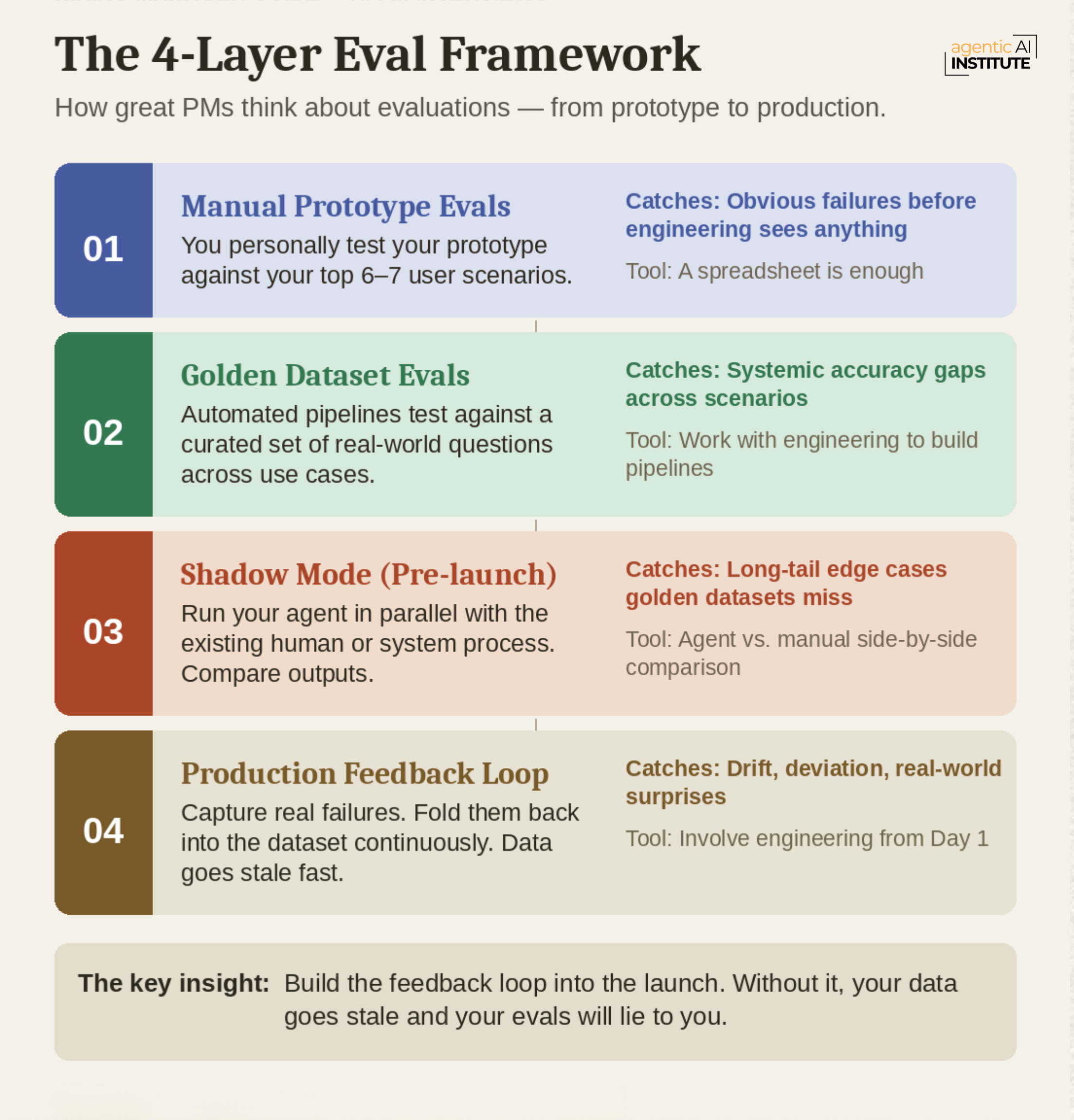
Here’s a simple framework for how to think about it, built from our discussion:
Layer 1 - Manual prototype evals. Before you show engineering anything, you should have tested your own prototype against your most common use cases. A spreadsheet works. You know your users better than any automated benchmark.
Layer 2 - Golden dataset evals. Work with your engineers to build a test set of questions across the real distribution of scenarios your product will face. This is where automated pipelines live.
Layer 3 - Shadow mode. Before you go fully live, run your agent in parallel with the human (or old system) process. Compare outputs. This surfaces long-tail edge cases your golden dataset will miss.
Layer 4 - Production feedback loop. Build the feedback loop into the launch. Talk to engineering early: “I need a mechanism where new failures get captured, logged, and folded back into evaluation.” Data goes stale. Without this, you will drift.
One more thing our cohort member, Divya, added that stuck with me: ask if the decision is reversible. Blocking a seller, sending a wrong electrical recommendation, and giving an unauthorized discount - these have wildly different recovery costs. Design your automation thresholds around reversibility, not just accuracy.
The Meta Lesson: PM Interviews Are MMA, Not Boxing
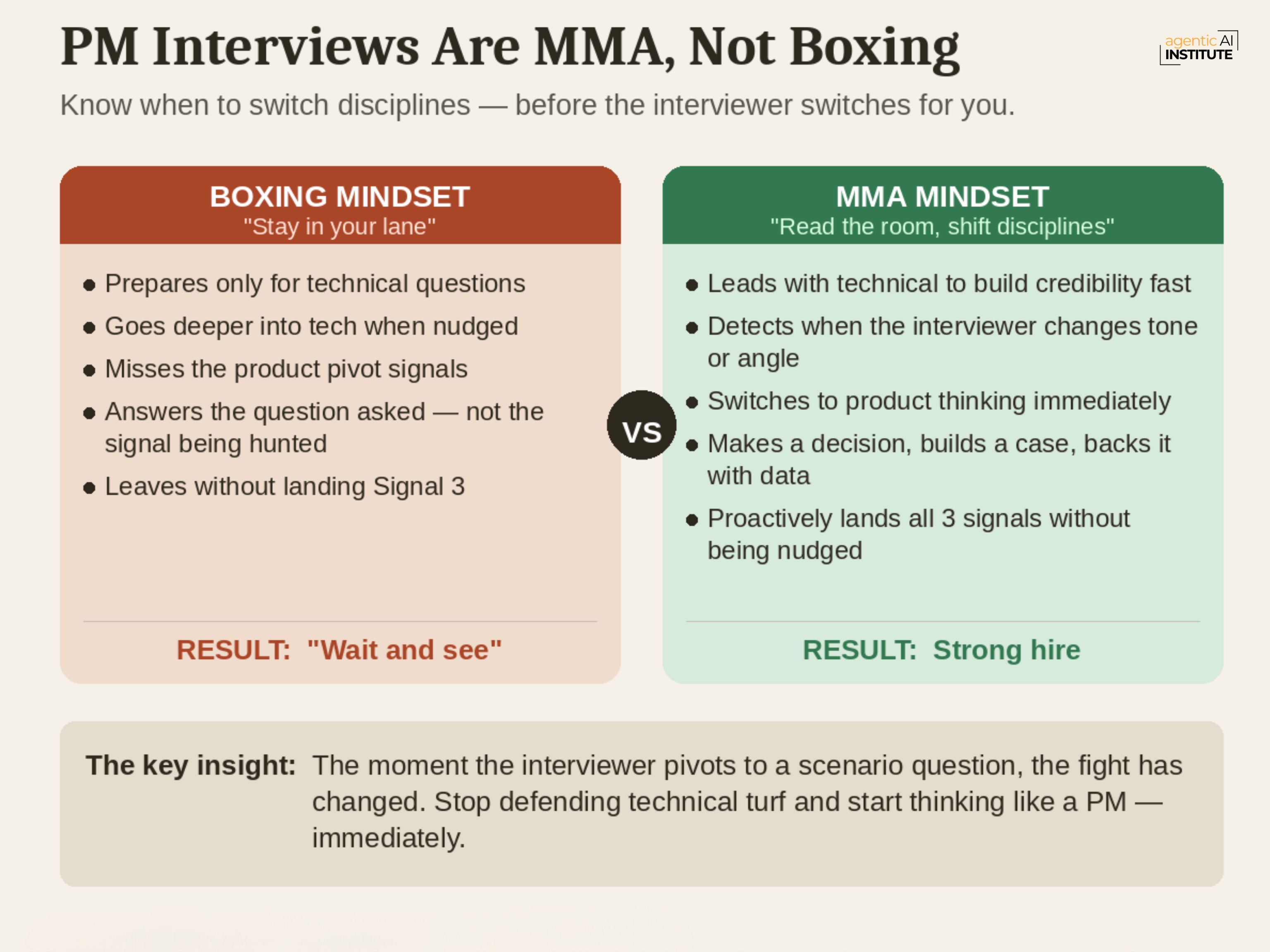
Most candidates prepare for boxing - 1 skill, 1 stance, 1 discipline.
PM interviews, especially technical ones, are MMA. You need to show up with everything.
Yes, the round is called “technical.” Yes, you should establish your technical credibility early. But the moment I pivot you to a product scenario, the right move is to recognize that the fight has changed disciplines. Shift your weight. Stop defending your technical turf. Start thinking like a PM: customers, revenue, risk, trust, decision-making, go-to-market.
The candidates who get offers are the ones who pick up on that pivot and move with it. The ones who don’t - even the very technical ones - leave the room as “wait and see.”
The One Thing You Can Do This Week
Stop preparing for the interview. Start doing the interview.
Apply for roles now - even if you think you’re not ready. There is no better preparation than the real thing. If you get a call, you can accelerate your prep for a focused 7-day window. If you don’t get the call, that feedback is valuable too.
The simulation - the mock interview, the live debrief, the breakout practice - is how you compress months of learning into hours. But the simulation is not the game. The game is the game.
Play it.
Ready to Go Deeper? Join the Next Cohort - Starting June 28th
Everything in this article, the three signals, the nudge system, the eval layers, the product judgment under pressure - we go deep on all of it in the upcoming cohort, with live mocks, real feedback, and people who’ve been through the exact interviews you’re preparing for.
Here’s what six weeks looks like:
21-day prep plan drops before Day 1, plus a Q&A with Mahesh to calibrate exactly where you are
The technical interview decoded - what AI PM screens actually look like and how to navigate them
AI product sense sharpened, with a guest session from Brian Kemler, ex-Google and ex-Meta AI Product Leader
Real case studies from vibe to production-ready, plus a session with Charu, Founder at rolestack.ai
Live hot seat - you or a cohort member interviews in real time, Mahesh breaks down what good looks like and where candidates lose points
The hiring manager’s lens - Mahesh plays the interviewer and narrates exactly what he’s evaluating on technical and product dimensions
Alumni Q&A with people who landed AI PM roles - what worked, what they’d do differently, what’s actually happening inside these teams
Another round of live mock interviews. The view from both sides of the table. A room full of people building the same muscle.
Join today → maven.com/mahesh-yadav/ai-pm-interview-prep-bootcamp - use code MAVEN100 at checkout.